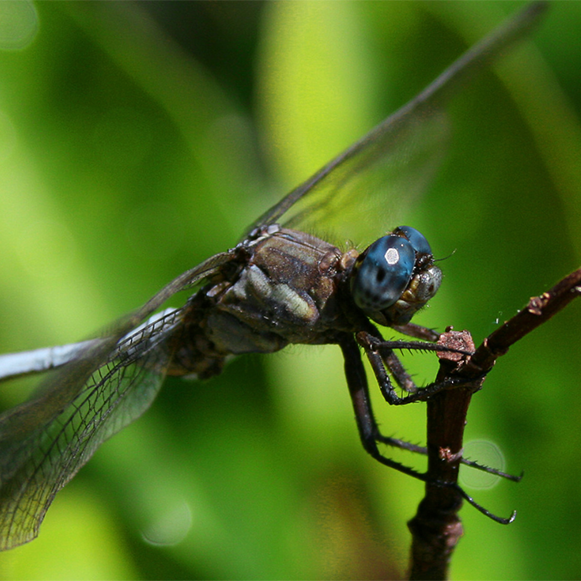
Sturgeon Bay, Wis. (May 29, 2026) – The Summer at Crossroads theme this week is dragonflies—an appropriate choice, in that these remarkable insects are now darting and gliding throughout the preserve.
On Monday, June 8, at 2:00 p.m., librarian Beth Lokken will introduce the theme with an outdoor storytime featuring the book Are You a Dragonfly? written by Judy Allen and illustrated by Tudor Humphries. Throughout the week, the pages of the book will be displayed along our Trail Tale storybook trail, which begins at the West Trailhead.
Most people recognize adult dragonflies, but many do not realize that dragonflies spend most of their lives underwater in an immature stage called a nymph.
Dragonfly nymphs are fascinating—and a bit fierce. These immature insects creep along the mud, silt, and sand at the bottoms of lakes, ponds, and streams. They look very different from the graceful adults we see flying above the water.
There are many species of dragonflies, but most nymphs share a similar appearance: stout bodies, large eyes, six legs, and short antennae. When they hatch from eggs, young dragonflies have no wings, but they do have enormous appetites.
Newly hatched nymphs feed on tiny aquatic organisms such as protozoans. As they grow, they become formidable underwater predators capable of catching mosquito larvae, tadpoles, small fish, and even other dragonfly nymphs. Their excellent vision and sensitivity to movement help make them highly effective hunters.
Some dragonfly nymphs stalk their prey, while others rely on ambush. Their most impressive hunting tool is a specialized lower lip called the labium. Normally folded beneath the head, the labium can suddenly extend outward with astonishing speed to seize prey.
A dragonfly nymph carefully judges distance, waits until prey comes close enough, and then shoots out this hinged “mask” to capture its victim. In an instant, the prey is pulled back to the mouth, where it is quickly consumed.
As the nymph grows, it must molt repeatedly because its hard outer covering, or exoskeleton, cannot expand. During each molt, the old skin splits open and the nymph wriggles free, revealing a larger new exoskeleton beneath.
Dragonfly nymphs may live underwater for months or even several years, depending on the species. With each molt, they begin to look more and more like adult dragonflies.
Eventually, wing pads appear on the thorax. With every successive molt, these pads become larger and more developed. After many molts, the dragonfly is finally ready to emerge as an adult.
Although wing pads are not useful for flying, dragonfly nymphs have another remarkable adaptation: underwater jet propulsion. By forcefully expelling water from the abdomen, they can rapidly propel themselves through the water—an effective escape strategy when threatened by predators.
On Thursday, June 11 at 2:00, ecologist Mike Grimm of The Nature Conservancy will guide visitors through the basics of dragonfly identification, highlighting key features that distinguish different species as well as the remarkable life cycles of these ancient aerial predators.
Whether you are a seasoned naturalist or simply curious about the colorful flashes zipping above ponds and wetlands, this program offers an engaging introduction to one of nature’s most captivating groups of insects. Participants will learn how dragonflies grow, hunt, migrate, and contribute to a healthy ecosystems. “For more information about Summer at Crossroads, visit https://bit.ly/summeratcrossroads
While this week’s focus is dragonflies, there are many other aspects of nature to enjoy at Crossroads. On Friday, June 12, at 5:00 a.m., Crossroads will conduct a three-point-count bird survey at the Ida Bay Preserve. Visit Crossroads at Big Creek for more information and to register.
Early summer is one of the best times to experience the wetlands at Crossroads, where dragonflies, birds, and blooming native plants are all part of the season’s activity.
Thanks to the generosity of our donors, Crossroads trails are open to the public 24/7 free of charge.


 ALL CONTENT © 2026 BY DOOR GUIDE PUBLISHING


