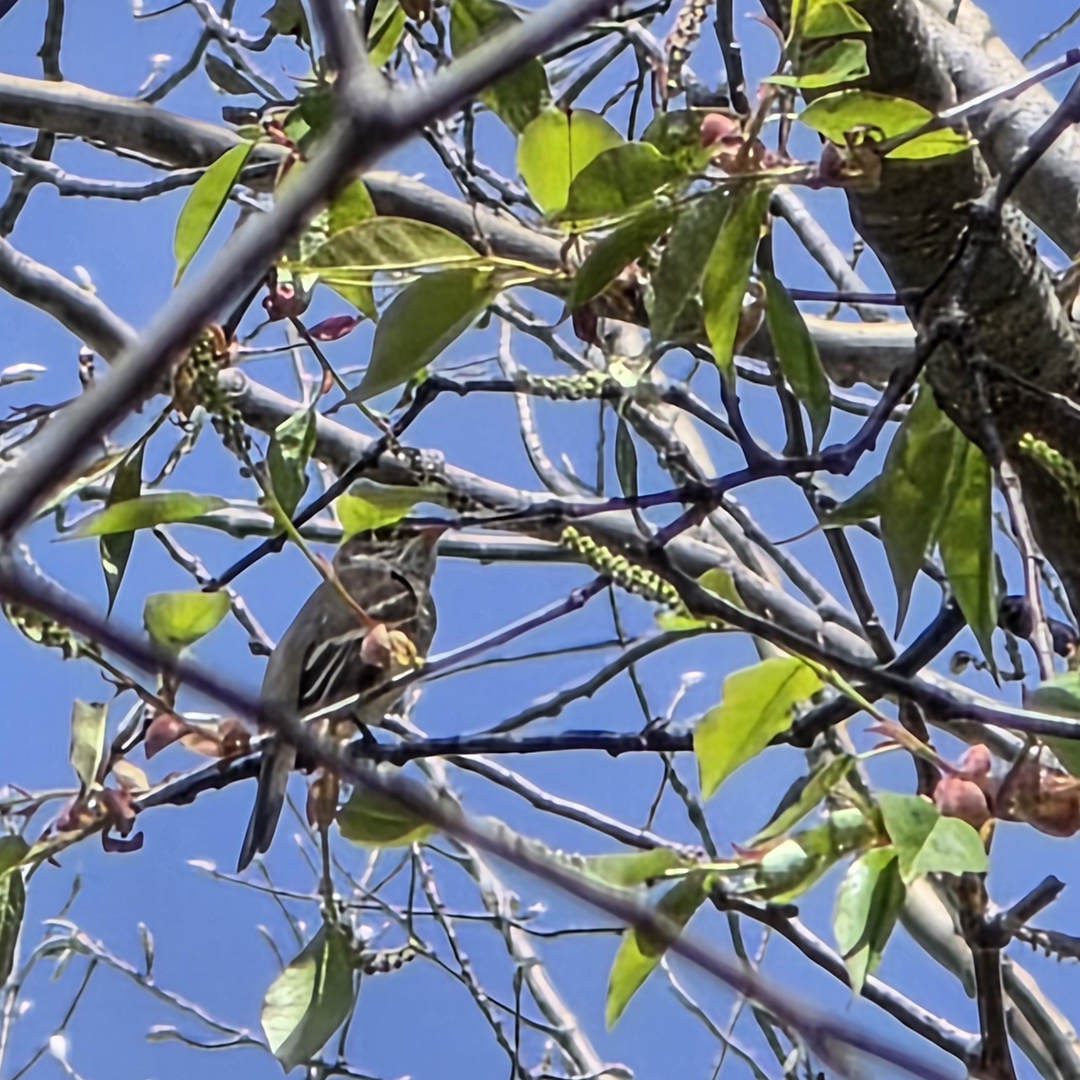
“Birds” is this week’s Summer at Crossroads theme, and this time of year our skies, forests, and shorelines are alive with activity as resident and migratory birds feed, nest, and raise their young. Door County sits along a major migratory flyway, making early summer an especially rich time to observe species that rely on a remarkable suite of adaptations—lightweight hollow bones, powerful flight muscles, and feathers uniquely designed for both lift and insulation.
The week starts with a Tale. At 2 pm on Monday, July 6, Door County Librarian will read the storybook, “The Birdwatchers” written by Simon James. (And for those who can’t make the story time, the pages of this book will be posted on our Trail Tales storybook walk which starts at our West Trailhead.)
Journeys with Joan, our weekly family program, will explore Fantastic Flyers at 2 pm on Tuesday, July 7, where participants will learn how wing shape influences flight—broad wings for soaring hawks, pointed wings for swift, agile swallows. Hikers participating in Wandering Wednesday at 1:30 pm on July 8 will observe birds each species filling their own ecological niche.
For our 2 pm Thursday Talk, our presenter will be Paige Witek of the Door County Land Trust, who will introduce participants to a variety of local bird species and highlight the strategies they use to attract mates, build nests, and ensure their chicks survive—from elaborate courtship displays to carefully constructed nests that regulate temperature and protect fragile eggs.
And throughout the week… and the rest of summer, stop by during open hours (Monday-Friday from 9:30 am-3:30 pm) for Tinkers, self-led, hands-on activities designed for curious minds. Take part in a bird scavenger hunt, explore how different beak shapes are adapted to specific diets, and create your own binocular craft.
Birds are equipped with extraordinary sensory and physical adaptations. Many have vision far sharper than humans, with some species able to detect ultraviolet light. Their highly efficient respiratory system uses air sacs to maintain a continuous flow of oxygen—an adaptation essential for sustained flight.
These incredible feathered vertebrates occupy nearly every habitat on Earth and live at the boundary of land, water, and sky. Some species soar on thermal updrafts, conserving energy over long distances, while others use rapid wingbeats to hover or dart with precision in pursuit of insects.
Their behaviors are equally fascinating. Songs and calls are used for communication, territory defense, and mate attraction, and some species are even capable of learning and mimicking sounds. Camouflage, flocking behavior, and rapid takeoff all help birds avoid predators.
When it’s time to raise their young, birds demonstrate remarkable engineering skills. Nests may be woven, excavated, or sculpted from mud—each designed to balance protection, insulation, and stability. Many parent birds make hundreds of feeding trips each day as their chicks grow.
The week wraps up with an opportunity to contribute to real science. Join Crossroads bio inventory efforts to document bird species at our Ida Bay Preserve as part of ongoing restoration work. Participants will help conduct standardized point counts following Wisconsin Breeding Bird Atlas protocol recording birds seen and heard within a fixed time and distance to help track species presence and abundance.
We will quietly observe and record birds visually and by sound—an important skill, as many species are more often heard than seen, especially during the breeding season when songs are used to establish territory.
Thanks to the generosity of our donors, Crossroads trails are open all day, every day, free of charge.


 ALL CONTENT © 2026 BY DOOR GUIDE PUBLISHING


