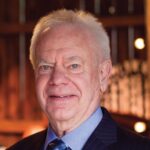
By Jim Berkenstock, Artistic Director
Midsummer’s Music will reconvene with three separate programs (eleven concerts total) on Sunday, August 23rd and continuing through Labor Day when we close with our spectacular Labor Day Gala at Bjorklunden. The first of these programs entitled, “The Poetry of David Perry,” features one of this country’s finest violinists, our own David Perry, in the most famous work by the late 19th century French composer, Ernest Chausson. It is a work usually heard on symphony programs because it was originally written for Violin and Orchestra and is called simply, Poème. At least, I think it was originally written for orchestra, but we are performing it in another version created by the composer himself, for Solo Violin, Piano, and String Quartet. To tell the truth, I am not enough of a Chausson scholar to know which came first (or if it is even possible to know). It would make considerable sense to think that he first conceived the work in its smaller form and then orchestrated into its larger version, but I know of no evidence for that.
The chamber music version that we are doing mimics, at least in instrumentation, another fascinating work that Chausson wrote for the very same instrumentation, his Concerto for Solo Violin, Piano, and String Quartet. Poème, in its orchestral version, dates from 1896, only three years before his untimely death in 1899 at the age of 44. The Concerto dates from a few years earlier. And just to add a little more intrigue, I recently discovered that among his unfinished works are conceptual sketches for another chamber concerto for solo piano, oboe, viola, and string quartet. This is something he was presumably working on at the time of his death. So, a fascinating question arises, did he have in mind orchestrating all of these concertos? And, did all three works start out in similar chamber versions, including Poème? Regardless, it is obvious that Chausson was fascinated by the idea of the chamber “concerto,” having been involved in three such efforts.
The idea of a concerto in a chamber music setting brings up some other questions. What is the proper role of the musician in chamber music? We know that it is fundamentally different from being an orchestral musician. For one thing, each musician has his/her own part. No one else is playing that part, and that is very different for the string players. There is also no conductor. Typically, we think of chamber music as being more democratic. Each musician has a say in things, particularly in rehearsals. However, at any given moment, one instrument may have the most dominant part that may give their concept of things more sway. If the viola has the most prominent part, the others have to make sure they are not too loud, and they will follow the violist’s lead regarding interpretative matters. In other words, they have to be responsive and considerate. As a practical matter, however, the first violin usually has the most demanding part and is usually given the most deference.
On the other hand, the first violinist can’t be expected to do everything. There are many occasions in quartet music where the first violin part is very virtuosic, and the player, quite literally, has his hands full. In such situations, the other three players may be acting somewhat in an accompanying role but functioning almost as a separate unit. Obviously, they have to be keenly aware of what the first violinist is doing, but they also have to work together as a supporting unit. In such cases, the second violinist may be the leader of that subsidiary instrumental support group. Over the years, I have had the pleasure of being a friend and colleague of the violinist, Joel Smirnoff, dating back to his early years in Chicago when we were colleagues in the Lyric Opera Orchestra. Joel went on to eventually join the famed Juilliard String Quartet, initially as second violinist, and then, when Robert Mann retired, he took over as the first violinist. Joel told me that, although he really liked being the first violinist, he also very much enjoyed being the second player because he said he often had more control of the group in that role. This also reminds me of a point that the great French conductor, Pierre Monteux, made. Monteux was Music Director of the Boston Symphony, but he also, as a young man, conducted the world premiere of Stravinsky’s Rite of Spring in Paris in 1909. Later in his life, he held a symposium for young orchestral conductors near his summer home in Hancock, Maine. I played in the orchestra there shortly after his death and heard about his methods. One of the points that Monteux stressed to young conductors was, don’t be so obsessed with the melody. Conduct the accompaniment. He knew that, like in a fine Swiss watch, it wasn’t the elegant case that was the only thing to notice, the inner workings of the mechanism were pretty important as well in making the thing work.
While many chamber music works are wonderful examples of an egalitarian approach to music where each instrument plays an important part and changing role, the first two works on our up-coming program are very different. We start the program with a work featuring our violist, Sally Chisholm. Sally is the violist with the Pro Arte Quartet in Madison, where she is a colleague of David Perry. She will be featured in a work called Scène Andalouse by Joaquin Turina, a Spanish composer educated in Paris. It is a very sensuous and evocative piece that depicts a lover serenading his sweetheart. It is set in Andalusia, the southernmost area of Spain, which includes Seville and the tip at Gibraltar. The serenading lover is the viola. The first movement, Crepuscule du Soir (At Twilight), sets the scene, followed by the real serenade itself, where the beautiful young girl appears À la Fenêtre (At the Window). Pizzicato in the strings create the sense of a guitar being played, and hints of tango and other folk elements add to the sensuality. The instrumentation is very similar to the Chausson except that the viola replaces the violin as the solo instrument.
After the Chausson, we turn to the voluptuous Piano Quartet No. 1 by Gabriel Fauré, which will bring our brilliant pianist out of the relative shadows of the first half into full light. Everyone has a big role in this work, but it shows the power and depth that a piano can bring to a chamber work, especially in the hands of Jeannie Yu, our beloved pianist.
Before I close, I have to give you a bit of back-story regarding the Chausson, especially as it relates to finding this chamber music version. As a bassoonist playing in various orchestras, I was familiar with the orchestral version of Poème having played it a few times in concert. However, I was not aware of the chamber music version. I am often asked how I find some of the unusual repertoire we program from time to time and how we obtain the music. Here is my answer, at least as it refers to this most peculiar situation.
In my past life as a bassoonist, I did a certain number of recordings – popular, classical, industrial, commercial, etc. Because of that, I was entitled to become a member of NARAS, the National Association of Recording Arts and Science. This is the organization that gives out the Grammy Awards. As a member, I was entitled to nominate recordings for an award and to vote on those nominated for an actual Grammy. In order that members could be familiar with the new recordings, we were offered a very, very low price on new CDs. Every few months, we would receive a list of new recordings and an order form. This was like manna from heaven for someone like me. I would scour the offerings for chamber music recordings and order (over time) way too many recordings. I had special drawers built in my new study just for them. Although I thought I had created enough capacity for the future, I now have a significant number in boxes on the floor because the drawers are full and have been for some time. I am no longer a member of NARAS, so that addiction has been cured. I am still working on the remaining ones. I only order a recording on rare occasions now because of what the internet offers.
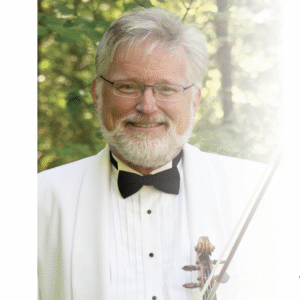
Wouldn’t you know it, one of those phantom recordings I ordered all those years ago was a very nice one that contained the chamber music version of Poème. With our having a great violinist like David Perry, I was immediately excited. When I talked to David about it, I was surprised to learn that he had never done it. It turns out that his sister, also a violinist, did the work when they were growing up, so, he kind of avoided it feeling, I guess, that it was just her piece. However, he now seemed interested especially in this chamber version. So, I got to work trying to find the music.
I soon realized that it was not published! Drats! This was not going to be so easy. It also looked like it had never been published. It appeared to me that the group that had recorded it had found a manuscript copy somewhere in a library and made their own edition. Furthermore, the group who recorded it was from Europe, so their source was likely a European library. I was getting nowhere fast, and I only have so much time to spend on lost causes. I have to find works we can actually play and not get too far down dead-end rabbit-holes. I did write to the address of the group on the recording, but heard nothing back. I dropped it, at least for the time being. A few years went by, and I encountered a musicologist at Lyric Opera who was giving a pre-performance talk to the audience before Mozart’s Magic Flute. I got to know him, and we had several long talks.
A few years went by, and he returned to do a talk for another opera. He told me that in the summers, he often travelled to Europe to do research in their libraries. I got the idea to tell him about the Chausson and my quest. He said he had a couple of European friends who might know something or could find out. Several weeks went by, and I got an email saying that one of them had located copies in two different libraries, one in Vienna and the other in the Czech Republic (as I recall). They were in manuscript, presumably the composer’s hand, and only in score form – no individual parts.
I was very excited, but the thought of copying out the parts for all the instruments was quite daunting. I used to do copying for composers in college for a little extra money. It is tedious and slow work. And, some composer’s writing would be better described as “scribbling.” Have you ever seen one of Beethoven’s manuscripts? You have to be clairvoyant to decipher those things. My idea again went to the back of the shelf.
Then, earlier this year the thought came to me again. So much is new on the internet, I decided to take a look. With a few clicks, there it was, but still as a score in the composer’s hand. However, Chausson’s writing was quite fastidious. My mind started racing, and I remembered doing some yard work with Jacob Alexander, the son of our Executive Director, Allyson Fleck. Jacob is about to start his second year in music at U.W. Madison studying viola with Sally Chisholm. I remembered that he had told me that he was working on writing a symphony. I was pretty sure if Jacob was serious enough to write a symphony, he probably had learned one of the computer programs for notating music. I thought that, maybe with his connection to Midsummer’s Music, we could get him to work on a project for us transcribing the Chausson score and creating parts for the musicians to play from.
On Sunday, August 23rd, at the Kress Pavilion, we will not only get to hear the mastery of David Perry at its most sublime, we will also get to enjoy Jacob’s handiwork. Not all works require this extent of effort to bring them to the audience, but not many organizations have the depth and degree of talent(s) to pull off this kind of accomplishment. It will be a feast of riches with Turina, Chausson, and Faure in the hands of some of the best musicians in the country. Bring a healthy musical appetite because you’re in for a splendid banquet.
Here are the dates, times and locations:
• Sunday, August 23, 4:00 pm, Kress Pavilion, Egg Harbor
• Friday, August 28, 7:00 pm, MUSE, Sturgeon Bay
• Saturday, August 29, 7:00 pm, St. Luke’s Episcopal Church, Sister Bay
• Wednesday, September 2, 7:00 pm, Bjorklunden, Baileys Harbor
This is a sensational program, so call 920-854-7088 or visit www.midsummersmusic.com for tickets or more information. Tchaikovsky’s string sextet, Souvenir of Florence, follows soon on the heels of this program and then the Brahms’s Piano Quartet in G Minor along with Paul Schoenfield’s much requested Café Music on our third program. Get some rest and take your vitamins. It’s going to be a wild ride!


 ALL CONTENT © 2026 BY DOOR GUIDE PUBLISHING


