By Coggin Heeringa
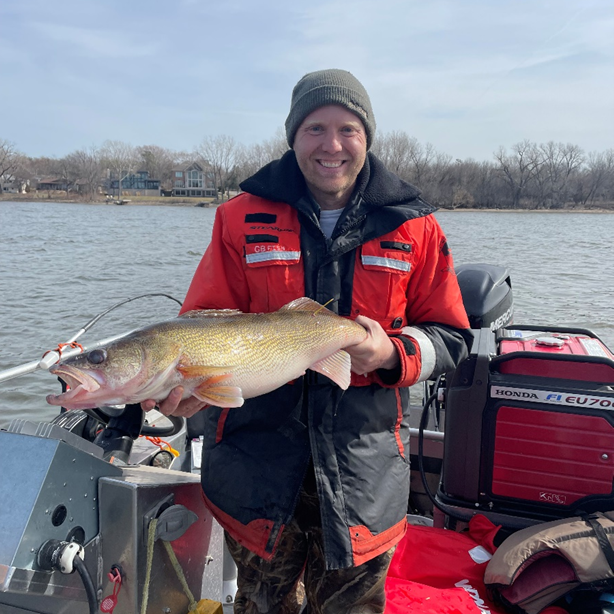
Walleyes are the topic for Crossroads at Big Creek’s next Fish Tales Lecture, scheduled for Thursday, February 12 at 7:00 pm. Dr. Jason Breeggemann, Senior Fisheries Biologist with the Wisconsin Department of Natural Resources, will present “Management of the Green Bay Walleye Fishery.”
Crossroads displays two mounted walleyes in the Great Lakes Exhibit on the entry level of the Collins Learning Center. Visitors often find them fascinating—not only because the walleye is Wisconsin’s state fish (yes, Wisconsin has a state fish), but because their eyes look so unusual. The eyes of a live walleye are even stranger: they appear to glow in the dark.
They do not truly glow, of course. Instead, walleyes have a special reflective layer in their eyes called the tapetum lucidum. This adaptation allows them to see extremely well in low light, making them most active near the surface at dawn and dusk. At other times, they prefer dark or murky water, where this visual advantage helps them hunt prey.
Walleyes are especially active in spring, when they must fatten up in preparation for spawning, and again in fall, when they build fat reserves for winter. They do not hibernate, but continue moving and feeding under the ice at a slower pace. Cold temperatures reduce their metabolism, yet they still need to eat, and dawn and dusk remain their most active periods even in winter.
Many people wonder whether walleyes are as plentiful as they once were. At the Fish Tales Lecture, Dr. Breeggemann will explain his research, describe how data are collected in Green Bay, and address questions about the current status of walleyes beneath the ice.
Gardeners slow down in winter too, but around this time of year—perhaps prompted by the arrival of seed catalogs—they begin planning gardens and landscapes. On Tuesday, February 10, the Door County Master Gardener Association invites the public to a free program, “Growing Together: Rain Gardens 101,” featuring Karen Newbern. All are welcome, especially those with soggy areas in their yards who want to learn about this environmentally friendly landscaping solution.
On Saturday, February 7, in conjunction with the 2026 Winter Olympics and in recognition of how important ice is on the Door Peninsula, our Saturday Science program will be “A Melting Olympics.” Following our popular (and admittedly messy) “fun in the lab” format, each lab table will feature experiments and demonstrations highlighting the unusual properties of ice. Activities are designed for elementary-aged students, but learners of all ages are welcome.
One of ice’s most beneficial properties is that it floats. Local river otters take advantage of this, and while otters are known to eat slow-moving walleyes in winter, they tend to favor smaller, easier prey.
Weather permitting, our after-school Environmental Exploration program will include a hike to the Cove Estuary, where otters are known to live and take advantage of open water created by natural seeps. Participants will also have the opportunity to try kicksleds to better understand how otters move across snow and ice. An indoor alternative will be offered if conditions require.
Up-to-date information on trail conditions, closures, and open hours for our Ski-for-Free program will be posted on the ticker of the Crossroads website. Trails are open all day, every day, free of charge. When the Sturgeon Bay School District closes schools, the Collins Learning Center will be closed and all meetings and programs will be canceled.


 ALL CONTENT © 2026 BY DOOR GUIDE PUBLISHING


