By Jim Berkenstock, Artistic Director

Midsummer Music’s current program, which continues July 22-24, might be called “The Vienna of Haydn, Mozart, and Wranitzky.” However, none of these composers were actually born in Vienna. Mozart and Haydn were at least Austrian. Mozart was born in Salzburg and Haydn came from a small village named Rohrau on the opposite side of Vienna. Paul Wranitzky, the third composer on our program, came from Moravia, now a part of the Czech Republic. The point is, Vienna was a strong magnet for composers. It was the musical center of the universe at the time. Beethoven came there as a young man from his hometown of Bonn for the same reason the others did, it was the place to be if you were a serious musician. Wranitzky was one of many Czech composers who made their way to Vienna. Johann Nepomuk Hummel, who was on our last program also came from there as did Johann Vanhal, an excellent composer with whom Mozart and Haydn both played string quartets.
Of the three composers on our current program, Haydn may have spent the least part of his career actually in Vienna. Although he is heavily associated with Vienna, he didn’t really live there until he was semi-retired. For most of his life, he was employed by the Esterhazy family, four different princes over time, in what became an opulent palace, east of Vienna in what is now Hungary, that rivaled Versailles in France. The Esterhazys were a powerful part of the Austro-Hungarian royal family and under Prince Nicolaus, the palace came to reflect his importance. He also had a very strong appetite for music. Haydn was one of the last composers who spent most of his career under the patronage of a very wealthy family. Mozart started his career working for the Archbishop of Salzburg, but that ended rather badly and fairly quickly when he decided to make his move to Vienna. The archbishop was not happy. At Mozart’s dismissal, he was literally kicked on the backside out of the Archbishop’s office. If it weren’t for this act, we probably wouldn’t remember much about Hieronymus Joseph Franz de Paula Graf von Colloredo (the Archbishop and Mozart nemesis).
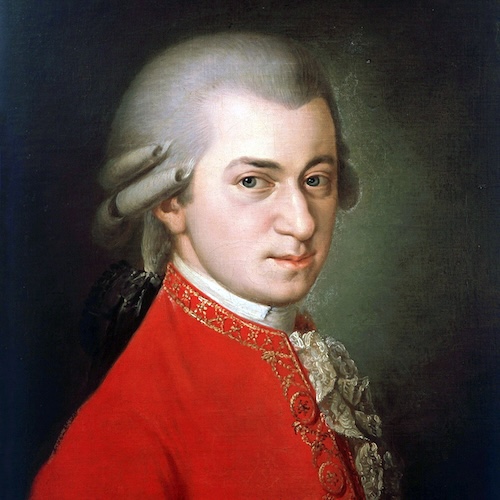
We begin our program with another of Mozart’s works for a solo instrument and strings, his Oboe Quartet in F Major, K. 368b. It stems from the very year Mozart left Salzburg for Vienna. In fact, he was looking for a job and travelled to Munich as part of his search. While there, he learned of new improvements to the oboe which extended its upper range to high F and became friends with Friedrich Ramm, a virtuoso, who could make the most of the new improvements. The Quartet was the result, and it, indeed, showcases the extended range of the new instrument quite dramatically, especially in the hands of our own oboist, Lindsay Flowers, who is Professor of Oboe at the University of Wisconsin in Madison.
If Mozart won out in the long run, our next composer on this program could well have been the envy of Mozart at the time. Paul Wranitzky, who was born the same year as Mozart, came to Vienna at the age of 20 and made great headway as a composer. Since Mozart didn’t arrive in Mozart until 1781, Wranitzky had a head start of five years. Judging by the number of operas and ballets written by Wranitzky, it appears that Wranitzky was more successful in infiltrating the important stages of Vienna. Mozart hoped for a position in Emperor Joseph II,’s court, but was unsuccessful on more than one occasion. He was beaten out by the Italian, Anton Salieri. Instead, Mozart had to rely on other cities for many of his premieres including Munich, Paris, and Prague. Finally, toward the end of his life, Mozart did have some success in Vienna with his last operas, but these were incidental productions and not the result of a court position.
In the meantime, Wranitzky, who was a friend of Mozart, Haydn, and Beethoven, had a large number of operas and ballets produced in Vienna on what seems like a regular basis. He also was busy writing at least 56 string quartets (some estimates are as high as 73), 44 symphonies, and a wide variety of other works including at least seven Sextets for strings, flute and oboe. The one in E-flat Major is on our program. Wranitzky’s orchestral works display a fondness for winds, which may reflect the taste of Joseph II who employed his own wind band known as the Harmonie. The result was that the Viennese of the day enjoyed their wind music, and it crept into larger forms. Of Haydn’s 12 church masses, one is called Die Harmonie Messe (The Wind-Band Mass) because of its extensive use of winds. It is not surprising that our Sextet would reflect this same taste with its delightful writing for the flute and oboe (played by Heather Zinninger and Lindsay Flowers). It is interesting to note that the quartet of strings employs two violas and only one violin. Apparently, with two soprano winds, Wranitzky sought to balance the upper voices with two medium range violas to give it a bit more weight.
Meanwhile, Joseph Haydn stayed out of the political fray and musical intrigue of Vienna until the end of his life when he was already a bigger-than-life celebrity. From 1761 until 1790, Haydn was the court composer to the Esterhazy family, and most of it was under the reign of Prince Nikolaus, who was an avid music lover. He also played the cello and a related folk instrument called the baryton for which Haydn wrote a considerable amount of music in the form of Baryton Trios (piano, violin, and baryton). For much of this time Haydn was sequestered on the Esterhazy Estate on the marshy plains of what is now eastern Hungary. Although he was not too far from Vienna, he didn’t have time to travel there very often because he was busy writing symphonies, quartets, operas, and church music for his employer and his opulent estate. The Esterhazy palace eventually had a theater, an opera theater, and even a little puppet opera theater. Prince Nikolaus was one of the most powerful members of the Emperor’s family, and he entertained many important functionaries for whom Haydn was supposed to provide entertainment. Nikolaus was enough of a musician himself to know what a talent he had in Haydn and took justifiable pride in putting his ability on display.
This all changed in 1790 when Nikolaus died. Although Haydn was asked to remain as Kapellmeister for Nikolaus’s son with his normal stipend, it didn’t require any work (!). His new employer liked having such a, by-now, famous composer on his staff but he didn’t have any interest in his music, so, for the first time in his life, Haydn was free to travel. Enter a savvy and wily violin virtuoso/composer/impresario by the name of Peter Salomon. Born in Germany, he now lived in London and managed a very successful series of concerts there. Having heard of the death of Nikolaus, he made a bee-line to Vienna in hopes of engaging the suddenly free Haydn. The two hit it off and by January of 1791, Haydn, now nearly 59-year-old, was on a ship at sea for the first time in his life. It was the first of two trips to London, each lasting more than a year, with the second one starting in 1794. Haydn was the toast of the town. He enjoyed celebrity status, some welcome attention from the ladies (especially one), and he wrote six symphonies on each trip. Collectively, these works are known as the London Symphonies, and they comprise his last 12 works in this genre.
Peter Salomon, in addition to being a great musician, was nothing if not a savvy businessman. He knew that Haydn’s symphonies were great works, but he also knew that sales of the music would be very limited because his orchestra was one of the few such groups in existence at that time. He approached Haydn with the idea of arranging them for a chamber group with the idea that sales would increase dramatically. Haydn, knowing of his ability as a composer, agreed to Salomon taking on the project. The result is the version we will be doing for flute and string quartet of Haydn’s famous “Clock” Symphony (No. 101 in D Major), and it comes from the second London visit.
Once the second movement begins, the reference to the clock is immediately apparent. The tick-tock is heard first in the strings and then in the flute and is unmistakable. We have done several of these London Symphonies in Salomon’s reduced version, and I find that I don’t really miss the orchestra. I certainly enjoy the full orchestra version, but I find these expert transcriptions have a vitality, clarity, and charm all their own that is very ingratiating. You have three opportunities to take in this splendid program at the following venues:
Wednesday, July 22, 7:00 pm., Woodwalk Gallery, Egg Harbor
Thursday, July 23, 7 pm., Kress Pavilion, Egg Harbor
Friday, July 24, 7:00 pm., Sister Bay Moravian Church
Please call 920-854-7088 or visit www.midsummersmusic.com for tickets or more information. Wranitzky was highly regarded by Haydn, Mozart, and Beethoven and is slowly receiving some much belated contemporary attention. Come see what you think and enjoy some great Mozart and Haydn at the same time. I look forward to seeing you there!


 ALL CONTENT © 2026 BY DOOR GUIDE PUBLISHING


