By Jim Berkenstock, Artistic Director
Our most recent program featured the music of Mozart, Haydn, and Wranitzky – composers steeped in the late 18th century Viennese style. They lived and worked within the Hapsburg Empire, which was seated in Vienna but ruled vast areas and cultures for hundreds of years. At first known as the Holy Roman Empire, it eventually became the Austrian Empire or the Austro-Hungarian Empire. Being a hodge-podge of cultures over vast distances, it was not easy to rule, and efforts to unify it by enforcing common elements like language and customs, were very unpopular. This was not of great significance for our three composers on our last program, but it had considerable bearing on the composers on our next program, “Passionate Perspectives.”
Bedřich Smetana and Zdeněk Fibich (approximate contemporaries of Dvořák) were both prominent Czech composers of the later 19th century. By this time, there was growing resentment in the many lands ruled by the Austrian Regime. The imposition of German as the official language, while practical and efficient from a ruling standpoint, was particularly chaffing. Austria’s efforts to homogenize the vast cultural divides were met with strong resistance and became particularly evident in music. Folk songs became more prized than ever and local dances like the mazurka, polka, polonaise, dumka, and furiant, reinforced regional pride. Music became a vehicle for expressing this sense of nationalism in many countries.
Smetana was a leader in Czech regions, well before Dvořák. In 1848, when revolutionary reaction to the Hapsburg Regime was breaking out in rebellions all over Europe, Smetana manned the barricades on the St. Charles Bridge in Prague but narrowly escaped imprisonment when the Austrians suppressed the rebellion. His orchestral tone poem, Má vlast (My Fatherland), is probably his most emphatic musical statement of his nationalistic pride. In the area of opera, he was a leader in the establishment of Czech opera based on nationalistic themes paving the way for Antonin Dvorak. Smetana’s Piano Trio on our next program is one of only a handful of chamber works he wrote. Coming from just a few years after the rebellion of 1848 it is full of heartfelt national song, but is also seriously affected by deep-seated melancholy resulting from the recent death of his daughter. It runs the gamut of emotional responses being both heart-rending, reassuringly transcendent, and imbued with his patriotic pride all at the same time.
However, things were different for Fibich. According to Wikipedia “…Smetana and Dvořák gave themselves over entirely to the national cause, consciously writing Czech music with which the emerging nation strongly identified, [but] Fibich’s position was more ambivalent. This was due to the background of his parents and to his education. Fibich’s father was a Czech forestry official[1] and the composer’s early life was spent on various wooded estates of the nobleman for whom his father worked.” However, his mother came from a German-speaking Viennese background. Home-schooled by his mother, who was also his piano teacher, he was sent at age nine to a school in Germany with classes taught in German. Two years later, he was in Prague in a Czech run school until age 15. His college instruction began in Leipzig under Moscheles, Salomon Jadassohn, and Ernst Richter followed by a stint in Mannheim with Vincenz Lachner. He then returned home and wrote his first opera in Czech based on a libretto by the writer who also provided one for Smetana’s Bartered Bride.
He wrote many operas, but some of them were not on Czech themes but on the works of Shakespeare, Byron, and Schiller, and his later operas were tinged with Wagnerian elements. None of this endeared him to the theater-going public, so he turned to more intimate works. The resulting chamber music has more overtly Czech melodies and rhythms along with folk style dances such as the dumka and polka. His most famous work is a monumental set of over 300 shorter piano works called Moods, Impressions, and Reminiscences. Parts of this work are autobiographical and reflect the passion that seized Fibich during a romantic attraction that developed between him and a student. He later married Anežka Schulzová, and she became his librettist for several of his later operas. Fibich did not live a quiet emotional life, and the many facets of his personality make his music interesting and compelling as his Piano Trio clearly demonstrates.
Astor Piazzolla is another story entirely. He came from a background in the popular music of his native country, Argentina. He decided he wanted to get an education in a more “classical” type of music, but ended up returning to his roots, this time with a more “sophisticated” approach to his beloved Tango.
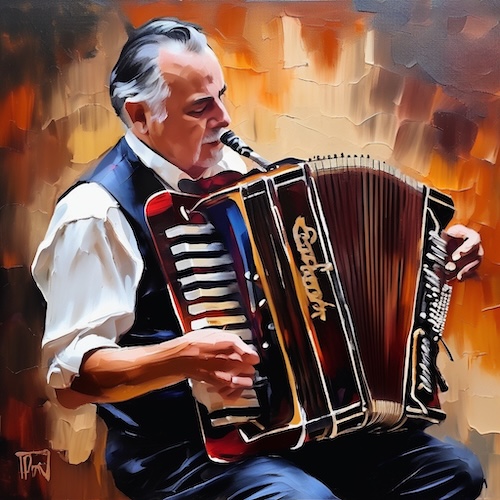
He was born in Playa dle Mar, Argentina in 1921, almost 100 years after Smetana and a big world away. When he was five, his family moved to New York City. He grew up listening to his father’s tango records but also heard jazz and pop and was exposed to Bach. When he was eight years old, his father brought home an instrument from a pawn shop that would change his life. His father had found a bandoneon, an instrument that is a part of the concertina family (somewhat similar to an accordion). Although it was invented in Germany it soon became a traditional instrument of Argentina and Uruguay, especially in tango music. It is so central to the folk music of those countries that the website organology.net describes it as “more than just an instrument, it is a symbol of cultural heritage.
After returning to Argentina when he was 15, Piazzolla soon found himself playing in some of the finer tango ensembles. Eventually he became a member of the finest tango orchestra in Buenos Aires and, before long, began also making arrangements for the group. The famous pianist, Artur Rubenstein, became aware of his talent and arranged for him to study with the greatest Argentinian composer of the time, Albert Ginastera. During his five years working with Ginastera he carefully studied the works of Stravinsky, Ravel, and Bartok, among others. At the same time, he kept up a grueling performance schedule playing with the tango orchestra.
His arrangements and compositions for the tango group began to take on musical characteristics beyond those the public expected and tensions rose within his orchestra. Meantime, Piazzolla began writing for full symphony orchestra and won a prize that allowed him to go to Paris to study with the famous 20th century teacher of composition, Nadia Boulanger. After seeing some of his attempts at writing “classical” music of the time that was influenced by the major contemporary composers, she asked to see some of his tango music. She was very taken with what she saw and urged him to return to his efforts in tango music where his true talents seemed to lie. Gershwin had a somewhat similar experience when he went to Paris to study with Ravel who told him, “I think I am the one who should be studying with you.” Both teachers saw in their would-be students the inherent value of their native musical instincts.
Piazzolla returned to Argentina and began composing a new style of contemporary music that was tango-infused. He wrote for his tango groups, but he also wrote for symphony orchestras. He wrote large scale works like oratorios, and he wrote a work, inspired by Vivaldi’s Four Seasons, entitled The Four Seasons of Brazil. It exists in a number of versions. We will be performing the piano trio version. It is a work full of color, flair, and tango-seduction.
Despite his best efforts to move away from his roots, the Tango won out and convinced Piazzolla that the nationalistic impulse of his native Argentina could not be denied. So, don’t deny yourself this opportunity to experience this exceptional music. They are fervent works that will leave you elated. Join us at the following:
Saturday, July 25, 7:00 pm., St. Luke’s Episcopal Church, Sister Bay
Sunday, July 26, 4:00 pm., Kress Pavilion, Egg Harbor
Tuesday, July 28, 7:00 pm., Hope Church, Sturgeon Bay
Wednesday, July 29, 7:00, pm., Shepherd of the Bay Lutheran Church, Ellison Bay
For tickets or more information, call 920-854-7088 or visit www.midsummersmusic.com. This music will make you want to laugh, cry, and dance. Prepare yourself!


 ALL CONTENT © 2026 BY DOOR GUIDE PUBLISHING


