By Coggin Heeringa, Crossroads at Big Creek
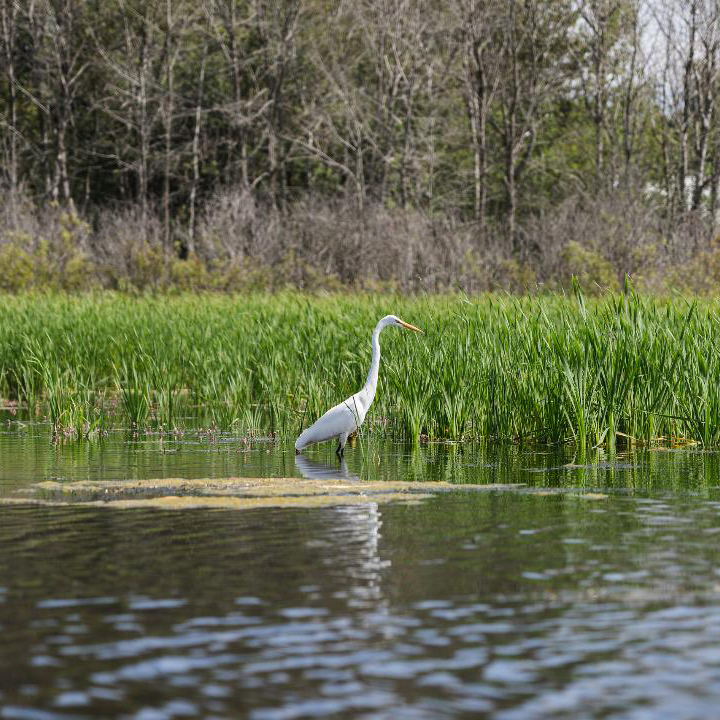
This week at Crossroads at Big Creek, we focus our binoculars—and our programming—on birds. Birdwatching has become far more than a pleasant hobby. Birds are often described as “biological barometers,” or indicator species, of environmental health. Because of our commitment to habitat restoration, we view them as a valuable metric for evaluating ecological integrity. Their presence—or absence—helps us gauge whether our restoration and tree-planting efforts are making a meaningful difference.
So why birds? They offer a rare combination of ecological importance and visibility.
First, birds can fly. This mobility allows them to respond quickly to environmental change. If a habitat becomes degraded and no longer provides sufficient food to support breeding adults and their young, adequate nesting sites, clean water, or suitable microclimate conditions, birds can move elsewhere. The reverse is also true: as habitat quality improves, we often see an increase in the diversity and abundance of breeding birds.
Birds also play many roles that influence ecosystem processes. Depending on the species, they may act as predators, seed dispersers, scavengers, or pollinators. By observing which species are present, land managers gain insight into different levels of the food web. Changes in bird communities can signal broader ecosystem shifts, making them useful indicators of ecological integrity.
They are also relatively easy to observe. Many birds are colorful, active during the day, and vocal, which makes them easier to detect and identify than many other wildlife groups. (For the record, Crossroads also monitors bats and frogs as part of our broader ecological work.)
Finally, some birds are highly selective about their habitat. Certain species require large tracts of mature forest, while others depend on a mix of habitat types—such as areas where young forest or shrubland occurs alongside older growth. Because of these specific requirements, the presence of particular bird species can tell us a great deal about habitat quality and diversity.
For this reason, creating a mosaic of habitats—with a diversity of native plant species and a range of age classes—is essential. Without this diversity, some bird species are unlikely to use an area for nesting. Conversely, when restoration goals are met, we may begin to see the return of sensitive or even rare species.
We are proud to participate each year in Global Big Day, an annual 24-hour birding event. In 2026, it takes place on May 9, in conjunction with World Migratory Bird Day. Bird enthusiasts around the world record species and submit their observations through eBird, contributing to a global dataset that supports conservation science. Organized by the Cornell Lab of Ornithology, this effort helps researchers track migration patterns, monitor population changes, and better understand the impacts of climate change.
At Crossroads, we’ll kick off the day with a morning birding jaunt at the Cove Estuary Preserve beginning at 6:30 a.m. on Saturday. Participants are also encouraged to bird throughout the day and submit their sightings.
Then on Monday, May 11, at 6:00 a.m., the public is invited to join us for a Birding in the Field Breakfast at the Cove Estuary Preserve. Registration is required—please visit our website for details and to reserve your spot.
Later that same morning, at 10:00 a.m., our Habitat Healers volunteers will be planting trees to increase biodiversity across our preserves—for birds and other wildlife now and into the future.
We welcome birders—especially eBirders—at Crossroads year-round. We also welcome anyone who wants to connect with nature.


 ALL CONTENT © 2026 BY DOOR GUIDE PUBLISHING


