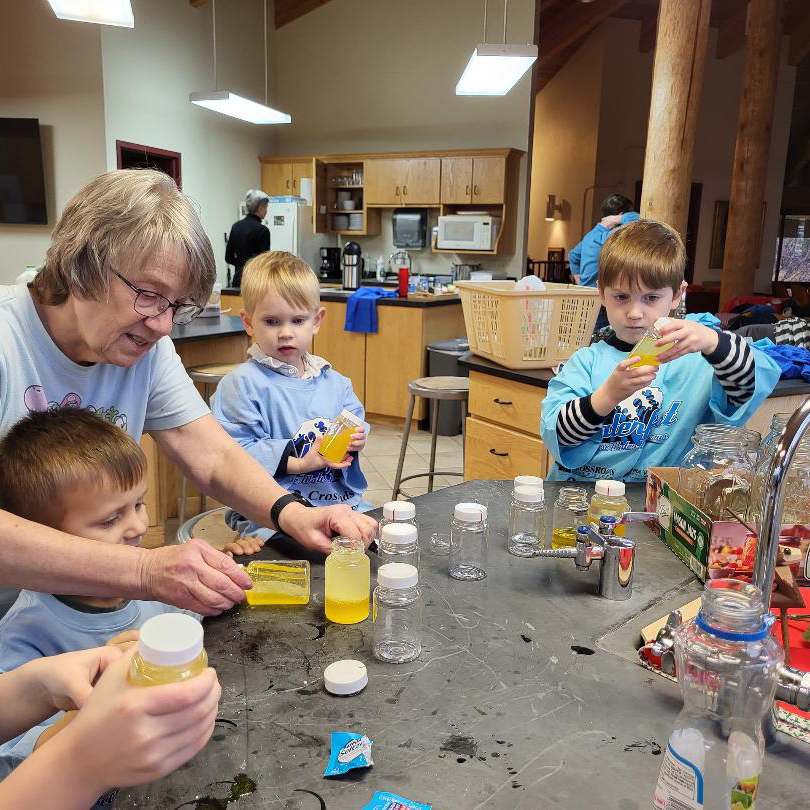
Sturgeon Bay, Wis. (January 6, 2025) – Winter has arrived at Crossroads at Big Creek in earnest, and much of the conversation this week has centered around ice. Is it thick enough to safely walk or fish on? Did you get caught in the flash freeze? Will the pipes burst? Ice—love it, hate it, or sometimes feel both at once—will be the focus of this week’s Science Saturday, our weekly family science program geared toward kids but engaging for learners of all ages. This interactive program will explore the global influence of frozen water.
Water is literally universal—it is found throughout space. We are often taught that without liquid water, life as we know it would not be possible. That is true, but it is only part of the story. Water is a strange substance, able to change from vapor to liquid, or liquid to solid, with relatively small changes in temperature.
According to NASA scientists, for life as we know it on Earth, the ability of water to exist in all three states—solid (ice), liquid (water), and gas (water vapor)—is necessary. While liquid water is the primary medium for the chemical reactions of life, the solid and gaseous forms play critical roles in regulating the planet’s climate, distributing water, and creating habitable environments.
Even young children learn about the water cycle and how water evaporates and then returns as rain or snow. Clearly, water vapor—the gaseous form—is essential. But ice plays a critical role as well.
Ice is the solid form of water, and peculiarly, it floats. If it did not, bodies of water from puddles to oceans would freeze from the bottom up each winter, killing aquatic life. Instead, a protective layer of ice forms on the surface, acting as an insulating blanket that allows fish and other organisms to survive in the liquid water below.
On a global scale, polar ice caps reflect sunlight back into space, helping cool the planet and regulate land temperatures and ocean currents. Melting glaciers also provide fresh water each year for agriculture, drinking water, and hydropower.
Closer to home, snow is made up of ice crystals—water in its solid form—and when that solid form is adequate for grooming, Crossroads offers Ski-for-Free. We lend skis, boots, poles, snowshoes in all sizes, and kick sleds to Door County residents and visitors from 9:30 AM to 3:00 PM Monday through Friday, and from 1:00 to 3:00 PM on Saturdays and Sundays. Ski-for-Free is open based on trail conditions and volunteer availability; for updates, check our events calendar and the ticker on our website.
Love it, tolerate it, or hate it, ice is essential, and Crossroads invites the community to celebrate it through winter science education and outdoor recreation.


 ALL CONTENT © 2026 BY DOOR GUIDE PUBLISHING


